
The 2026 MouthWatch Dental Practice Marketing Survey
This year’s dental practice marketing survey reveals how practices are marketing this year, which channels practices report are driving growth, and where the biggest opportunities remain. Spoiler: Google is catching up to referrals faster than most dentists realize, AI is changing how patients search, and the practices investing even modestly in their marketing are pulling ahead of those that aren’t.
Marketing Channels: Google Is Closing the Gap on Referrals
For years, “word of mouth” has been the answer whenever dental professionals are asked about their best marketing channel. That’s still true in 2026 but the picture is changing faster than most practices realize.
In our 2025 survey, 77.5% of practices named word of mouth and patient referrals as their top source of new patients. This year, with 448 respondents, that number dropped to 65.6%. Not because referrals got less effective, but because Google is becoming a genuine second engine for new patient growth.
Google Business Profile (organic) is now cited by 15.6% of practices as their top new patient channel, more than any paid digital option. When you add Google Ads at 7.6%, Google as a platform accounts for nearly a quarter (23.2%) of new patient attribution across survey respondents. That’s a significant jump from the roughly 17% total digital marketing success rate reported in 2025.
What does that mean practically? Practices that actively manage their Google Business Profile, keeping information current, responding to reviews, posting updates, and optimizing their service listings, are seeing measurable patient growth from it. Those who haven’t claimed or optimized their listing are essentially invisible in local search.
What’s working beyond Google: Local community involvement and sponsorships (3.3%), patient loyalty and referral programs (2.2%), and Facebook/Instagram ads (2.0%) round out the active channel landscape. Social media organic, direct mail, email marketing, and video content each account for less than 2% of reported new patient sources, meaningful for specific practices, but not broadly consistent drivers.
Key takeaway for 2026: Don’t wait for Google to become important. It already is. The practices with strong Google Business Profiles and a review volume above 100 are consistently outperforming those without. If you haven’t treated your GBP like core marketing infrastructure, 2026 is the year to start.
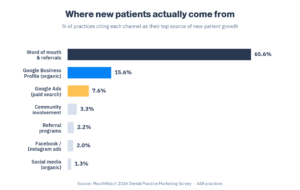
Most effective channels for new patient growth — 2026 survey of 448 dental practices.
Marketing Budgets: Modest Investment, Real Returns
Most dental practices continue to market conservatively. In our 2026 survey:
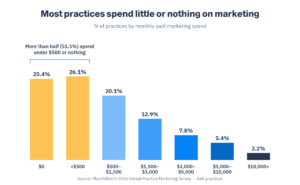
More than half of practices (51.5%) are spending under $500/month or nothing at all. That’s a significant portion of the dental market either not investing in marketing or investing at a very minimal level.
Here’s where the data gets interesting: when we cross-referenced monthly spend with marketing satisfaction scores, a clear pattern emerged. Practices spending nothing average a 5.7/10 satisfaction score. Practices spending $1,500–$3,000/month average 6.7/10. Those spending $5,000+ average 6.9–7.1/10.
The biggest jump in satisfaction happens between $0–$500 and $500–$3,000/month. You don’t need to outspend everyone to see better results. You need to go from nothing to something consistent.
As one respondent put it: “Invest in quality marketing, not necessarily more marketing. Every dollar should serve a clear purpose.”
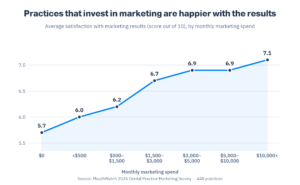
Practices that spend more report meaningfully higher satisfaction, with the biggest jump occurring between $0 and $1,500/month.
Key takeaway: You don’t need a large budget to improve your marketing results. The data consistently shows that even $500–$1,500/month in well-placed spend, like Google Ads, a managed Google Business Profile, or automated review tools, moves the needle meaningfully compared to doing nothing.
Marketing Performance: A Gap Between Effort and Measurement
When asked to rate satisfaction with their current marketing results, respondents gave an average score of 6.21 out of 10 (n=448). That’s a modest decline from 6.98/10 in last year’s smaller survey, likely reflecting the wider range of practices in this year’s dataset, including many that don’t actively market and are appropriately less satisfied with results.
The spread tells a more nuanced story: nearly a third of practices (31.9%) rate their satisfaction at 8 or higher, while 37.5% rate it at 5 or below. The gap between these two groups largely comes down to three things: budget, consistency, and measurement.
Measurement is the hidden problem. When asked how confident they are in knowing which marketing activities are driving new patients:
- 45.5% say they have a general sense but aren’t tracking closely
- 24.3% admit it’s mostly guesswork
- 10.9% don’t track results at all
- Only 19.2% say they track marketing performance closely
That means more than 80% of dental practices are making marketing decisions without solid data. The practices that score highest in satisfaction are almost universally the ones that have basic attribution in place, even something as simple as asking new patients “how did you find us?” and logging the answer.
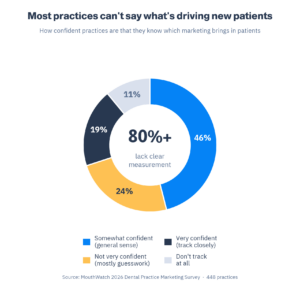
Only 19% of practices track marketing performance closely. More than 80% are making decisions with limited data.
Key takeaway: You can’t optimize what you don’t measure. The single highest-leverage change most practices can make isn’t a new marketing channel, it’s installing basic tracking so you know what’s already working.
Top Marketing Goals for 2026: Acquisition, Reactivation, and Reputation
Surveyed practices identified their primary marketing focus areas for this year:
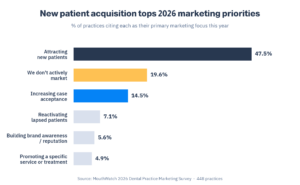
New patient acquisition remains the dominant focus, but it’s worth noting that 14.5% of practices are prioritizing case acceptance, getting existing patients to say yes to recommended treatment. This is a meaningful shift. As one respondent noted:
“You already have the patient in the chair. The real opportunity is helping them understand why the treatment matters.”
The 70.5% of practices that cite cost and insurance concerns as their top case acceptance barrier point to a communication and patient education challenge, not just a financial one. Practices that use visual tools like intraoral cameras, imaging, and before-and-after photos to show patients what’s actually happening in their mouth consistently report better case acceptance outcomes.
Online Presence: Most Practices Have Room to Grow
When asked to self-assess their online presence:
- 25.0% describe it as strong (ranking well on Google, solid reviews, consistent posting)
- 49.8% say it’s decent but could be better
- 18.8% say it’s weak and needs significant improvement
- 6.5% have minimal to no online presence
Three-quarters of practices acknowledge their online presence isn’t where it should be, even as Google Business Profile becomes the second-leading new patient channel. This gap is one of the biggest untapped opportunities in dental marketing today.
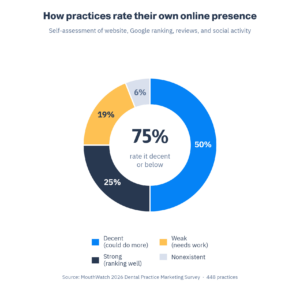
75% of practices rate their online presence as “decent” or below, even as Google becomes the #2 new patient channel.
Reviews are part of the story. Nearly half of practices (47.5%) have fewer than 100 Google reviews. Only 12.1% have 500 or more. The practices with the highest Google visibility and star ratings tend to be those that have made review generation a consistent habit, not a one-time push.
How practices collect reviews today:
- 47.3% use automated texts or emails after appointments
- 25.7% ask verbally at checkout
- 9.4% rely on patients to do it on their own
- 10.3% have no review strategy at all
The gap between “automated system” and “no strategy” is significant. Practices that automate review requests generate 3–5x more reviews than those that rely on manual asking or patient initiative.
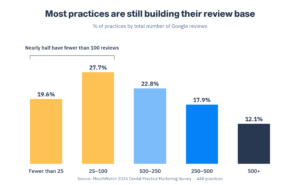
Nearly half of all practices have fewer than 100 Google reviews, leaving significant room to build visibility.
The AI Question: Most Practices Are Watching and Waiting
One of the new questions in our 2026 survey asked how concerned practices are about AI tools changing how patients find dental practices online. The responses were split:
- 43.5% are somewhat concerned but haven’t acted
- 30.6% aren’t concerned, it doesn’t seem relevant to their practice
- 16.1% are very concerned and actively thinking about it
- 9.8% aren’t familiar with how AI might affect patient search behavior
The majority of dental professionals are in a “wait and see” posture on AI and search. That’s understandable, the landscape is genuinely uncertain. But it’s worth noting that Google’s AI Overviews already surface in a significant portion of health-related searches, and tools like Perplexity and ChatGPT are increasingly being used for healthcare decision-making.
Patients are moving faster than practices. Recent research from TechTarget found that 47% of patients have used AI chatbots like ChatGPT or Gemini to find a healthcare provider, up from 31% just nine months earlier. And it’s not just casual browsing: 36% said AI influenced which provider they ultimately chose.
That’s a meaningful gap. Nearly half of patients are already using AI to search for providers, while only 16% of practices are actively adapting their strategy for it. The majority are waiting to see what happens.
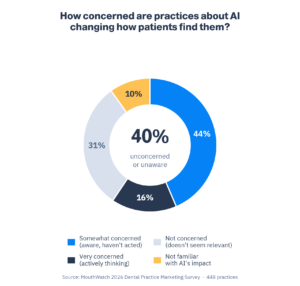
Only 16% of practices are actively adapting their strategy for AI-driven search. The majority are waiting to see what happens.
What does AI-ready dental marketing look like in 2026?
It’s not dramatically different from good SEO. It means having a well-maintained Google Business Profile, consistent reviews, clearly structured web pages with specific services and locations named, and content that answers the questions patients actually ask. AI search tools surface established, trusted sources, and that starts with the fundamentals.
What’s Actually Working: Tactics That Moved the Needle
We asked every respondent to share the single marketing tactic, tool, or habit that has genuinely driven results. Across 448 responses, clear themes emerged:
- Google reviews and reputation management. The most frequently mentioned tactic by far. Practices that actively request reviews, through automated systems, verbal asks, or follow-up messages, consistently outperform those that don’t. Review volume compounds over time: a practice that generates 10 reviews a month will have a dramatically stronger Google presence in 12 months than one that generates 1.
- Google Business Profile optimization. Multiple respondents specifically called out their GBP as their top driver, including one DSO respondent who described “Comprehensive Google Profiles with precise use of paid Google Ads” as the combination that works. An optimized GBP includes accurate hours, services listed with keywords, photos updated regularly, Q&A populated, and reviews responded to promptly.
- Delivering exceptional care. This keeps showing up for a reason. Referrals don’t come from average experiences, they come from patients who feel genuinely cared for and want to tell their friends. As one respondent put it: “Building meaningful relationships with patients, and then word of mouth. Patients talk about my practice on dental forums and websites.”
- Intraoral camera images. Seeing is believing. Practices that show patients their own condition, rather than just describing it, report better treatment acceptance and stronger patient trust.
- Automated post-appointment outreach. Whether it’s review requests, appointment reminders, or reactivation messages, automated communication converts passive patients into active reviewers, returning visitors, and referral sources.
- Community involvement. Local sponsorships, school events, and community health programs build name recognition and goodwill in ways that digital marketing alone cannot replicate.
Priorities for marketing your dental practice:
The 2026 data paints a consistent picture across 448 practices. The best marketing still starts with delivering genuinely great care, because referrals, reviews, and reputation all flow from that foundation. But the practices pulling ahead are also building the systems that amplify that care into visible, measurable growth.
Google is not optional anymore. Reviews are not a “nice-to-have”. Measurement is not something to think about later. These are the table stakes of dental practice marketing in 2026.
If we had to distill the 2026 survey into a three-step priority list for the average dental practice:
- Get your Google Business Profile in order. Complete it, optimize it, post to it consistently, and respond to every review.
- Systematize review generation. Set up automated post-appointment review requests. Aim for 10+ new reviews per month. Volume and recency both matter.
- Track one thing. Start measuring where your new patients come from. Ask. Log it. Even basic data transforms your marketing decisions.
The practices that treat marketing as essential infrastructure — not an afterthought — are the ones reporting 8s and 9s and 10s on the satisfaction scale. The gap between them and everyone else isn’t magic. It’s consistency.
About the 2026 Dental Practice Marketing Survey
This report summarizes responses from 448 dental professionals collected in June 2026. Respondents represent a range of practice types including solo practices, small group practices, DSOs, FQHCs, mobile/teledentistry providers, and specialty practices. The dental practice marketing survey explored marketing channel performance, investment levels, technology adoption, satisfaction, and awareness of emerging trends including AI-driven search.